If you have been searching for a certified tax advisor course in Pakistan, you already know that tax knowledge is one of the most in-demand — and highest-paid — professional skills in the country right now. Every business, every salaried individual, every freelancer, and every overseas Pakistani needs a qualified tax advisor. Yet certified, practically trained tax professionals remain rare.
At Elite Tax Training Center (ETTC) in Islamabad, we have trained hundreds of tax professionals across Pakistan through our certified, hands-on programs. This guide tells you exactly what a certified tax advisor course covers, who needs it, and why ETTC is the right place to earn your certification.
What Is a Certified Tax Advisor?
A certified tax advisor is a trained professional who helps individuals, businesses, and organizations understand and comply with tax laws. Unlike a general accountant, a tax advisor specializes in tax planning, return filing, tax minimization strategies, and representing clients before tax authorities like the Federal Board of Revenue (FBR).
In Pakistan, certified tax advisors work in:
- Private tax consultancy firms
- Accounting and audit practices
- Corporate finance and compliance departments
- Their own independent tax advisory businesses
- International accounting firms serving Gulf, UK, and US clients
The difference between a good tax advisor and a great one comes down to practical training — which is exactly what ETTC’s certified tax advisor course in Pakistan delivers.
Why Become a Certified Tax Advisor in Pakistan in 2026?
1. Tax compliance is now mandatory for millions
Since FBR began enforcing the Active Taxpayer List (ATL) and linking tax status to banking, property, and vehicle transactions, millions of Pakistanis are now required to file annual returns. Every one of them needs guidance, creating an enormous and growing market for certified tax advisors.
2. FBR is tightening enforcement every year
FBR’s digital transformation — including the IRIS portal and automated withholding tax systems — means businesses can no longer afford to make mistakes. They need qualified advisors who understand the system.
3. Businesses need ongoing tax support
From withholding tax deductions to monthly sales tax returns to annual income tax filings, Pakistani businesses generate year-round demand for tax advisory services. A certified tax advisor can serve dozens of clients simultaneously, building a highly scalable income.
4. International tax opportunities are expanding
Pakistani tax professionals who combine local certification with international tax knowledge — in UAE, UK, or USA taxation — can serve Gulf-based, UK-registered, or US-operated businesses from Pakistan, earning in foreign currency.
5. The earning potential is exceptional
A certified tax advisor in Pakistan can earn between PKR 80,000 and PKR 300,000+ per month in employment, or significantly more running an independent consultancy. International tax advisors serving Gulf or UK clients earn even higher.
What ETTC Certified Tax Advisor Course in Pakistan Cover
ETTC’s Tax Consultant Course in Islamabad is Pakistan’s most comprehensive certified tax advisor program. Here is the complete curriculum:
Module 1 — Pakistan Tax System Foundation
- Overview of Pakistan’s federal and provincial tax structure
- FBR’s role, departments, and enforcement powers
- Types of taxpayers: salaried, business, corporate, AOPs
- National Tax Number (NTN) registration process
- Introduction to the FBR IRIS login portal
Module 2 — Income Tax in Depth
- Income tax ordinance 2001 — key provisions
- Tax slabs for salaried individuals (2025–26)
- Business income computation — allowable and disallowable expenses
- Rental income, dividend income, and capital gains
- Minimum tax, alternate corporate tax, and super tax
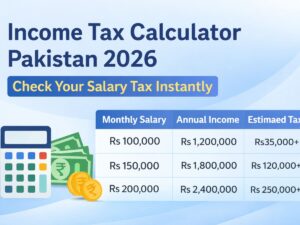
- Use our free Income Tax Calculator Pakistan 2026 to practise calculations
Module 3 — Withholding Tax (WHT)
- Over 50 withholding tax provisions explained
- WHT on salaries, contracts, imports, dividends, and rent
- Monthly WHT statement filing (u/s 165)
- Active Taxpayer List (ATL) impact on WHT rates
- Common mistakes and how to avoid them
Module 4 — Sales Tax
- Sales tax act 1990 — fundamentals
- Registration threshold and process
- Input tax, output tax, and tax invoicing
- Monthly sales tax return filing on IRIS
- Sales tax audits and notices — how to handle them
- Use our Supply Tax Calculator to practise sales tax computations
Module 5 — FBR IRIS Portal — Complete Practical Training
- FBR IRIS portal — full walkthrough from login to return submission
- Filing income tax returns for salaried individuals
- Filing income tax returns for business owners
- Wealth statement — how to prepare and file correctly
- Responding to IRIS notices and audit selections
- Read our detailed FBR IRIS portal guide before class for maximum benefit
Module 6 — Corporate Taxation
- Company registration and tax implications
- Corporate tax rates and minimum tax
- Business Tax Calculator Pakistan — practical exercises
- Dividend taxation and inter-company transactions
- Transfer pricing basics for multinationals
Module 7 — Agriculture Tax
- Provincial agriculture tax laws
- Who is liable and how is it calculated
- Practical computation using our Agriculture Tax Calculator
- Integration with federal income tax returns
Module 8 — Tax Regime Planning
- Normal tax regime vs final tax regime
- Which regime is better for your client — decision framework
- Use our Regime Tax Calculator for live regime comparisons
- Tax planning strategies for salaried and business clients
Module 9 — Tax Return Filing — Step by Step
- Complete income tax return for a salaried individual
- Complete income tax return for a sole proprietor
- Complete the income tax return for a company
- Wealth statement — assets, liabilities, and reconciliation
- Follow along with our ” How to file income tax return in Pakistan guide
Module 10 — Tax Advisory & Consultancy Practice
- How to set up your own tax advisory business
- Client onboarding and engagement letters
- Fee structures — retainer vs per-return pricing
- Handling FBR notices, audits, and appeals on behalf of clients
- Building a client base in Islamabad, Rawalpindi, and beyond
- Ethical obligations of a tax advisor
Free Tools to Use Before and During Your Course
ETTC provides the most comprehensive free tax resource library in Pakistan. Use these tools alongside your certified tax advisor training:
🧮 Free Tax Calculators
All five calculators are free to use at any time — practise with real numbers as you learn:
| Calculator | What It Does |
|---|---|
| Income Tax Calculator 2026 | Salary and personal income tax |
| Business Tax Calculator | Business and corporate income tax |
| Supply Tax Calculator | Sales tax on taxable supplies |
| Agriculture Tax Calculator | Provincial agriculture income tax |
| Regime Tax Calculator | Normal vs final tax regime comparison |
📖 Free Blog Guides
Read these before your first class to arrive fully prepared:
- FBR IRIS Login — Complete Step-by-Step Guide
- FBR IRIS Portal — Full Overview and Walkthrough
- How to File Income Tax Return in Pakistan
- Pakistan Tax Return — Complete Guide
- Tax Consultant Course + FBR IRIS Guide
- All Tax Blogs & Articles
After Certification — Upgrade to International Tax
Once you complete ETTC’s certified tax advisor course in Pakistan, you can expand your expertise globally with our international programs. Browse all options on our Courses page:
🇦🇪 UAE Tax Course
The UAE introduced 9% Corporate Tax in 2023, creating huge demand for Gulf-trained professionals. Our UAE Tax Course in Pakistan covers Corporate Tax, VAT, FTA portal training, and Transfer Pricing — perfect for anyone serving Gulf clients or working in the GCC.
🇬🇧 UK Taxation Course
ACCA students and professionals serving UK clients need structured HMRC training. Our UK Taxation Course in Pakistan covers income tax, PAYE, VAT, self-assessment, and Corporation Tax — aligned to ACCA TX-UK exam objectives.
🇺🇸 USA Tax Course
The US tax market offers the highest earning potential for Pakistani professionals. Our USA Tax Course in Pakistan covers federal income tax, Form 1040, business entities, payroll, and cross-border IRS rules — ideal for anyone serving American clients remotely.
Who Should Take ETTC’s Certified Tax Advisor Course?
This course is the right fit for:
- Fresh graduates in accounting, finance, commerce, or business administration who want a job-ready skill
- Salaried professionals who want to manage their own taxes without depending on a third party — start with our Pakistan Tax Return Guide.
- Bookkeepers and accountants who want to move into higher-paid tax advisory roles
- Business owners who want to understand their own tax obligations, FBR notices, and filing requirements
- Freelancers who earn from overseas clients and need to understand their Pakistan tax position
- Anyone who wants to set up their own tax consultancy in Islamabad, Rawalpindi, or online
Why Choose ETTC for Your Certified Tax Advisor Course in Pakistan?
Elite Tax Training Center has built a reputation as Pakistan’s most trusted practical tax training institution. Here is what makes us different:
Learn from Practicing Tax Consultants
Our expert mentor team does not just teach tax — they practice it every day. Our instructors handle real FBR filings, represent clients in audits, and manage corporate tax compliance for active businesses. You learn from people who live this work, not just academics.
100% Practical, Hands-On Training
Every session at ETTC is built around real scenarios. You will file actual returns on the FBR IRIS portal, work through real audit notices, and prepare complete tax computations from scratch. When you leave, you can start working immediately.
The Most Complete Tax Resource Library in Pakistan
No other institute offers five free calculators, six detailed blog guides, and a full course curriculum under one roof. From the Income Tax Calculator to the Regime Tax Calculator, ETTC’s tools support your learning inside and outside the classroom.
Flexible Schedules for Working Professionals
Morning, evening, and weekend batches are available. Online Zoom sessions are also offered for students outside Islamabad.
Recognised Certification
ETTC’s Certificate of Completion is recognised by employers, accounting firms, and corporate clients across Pakistan. It validates your practical competency — not just theoretical knowledge.
Central Islamabad Location
Our campus is easily accessible from all Twin Cities areas. Visit our Islamabad training centre contact page for current batch timings, location map, and fee structure.
Step-by-Step: What Happens in a Typical ETTC Class?
Here is a snapshot of a typical ETTC-certified tax advisor course session:
Opening (15 mins) — Quick recap of previous session. Students share any real-world tax questions they encountered during the week.
Core teaching (45 mins) — Instructor walks through the session topic (e.g. withholding tax on contracts) using the actual FBR law, real invoices, and live IRIS portal demonstrations.
Practical exercise (30 mins) — Students complete a guided hands-on exercise: computing WHT, filling in a tax form, or simulating an IRIS filing. Instructors review and correct in real time.
Case study (20 mins) — A real client scenario is presented. Students work in pairs to identify the tax issue, calculate the liability, and suggest the correct treatment.
Q&A and wrap-up (10 mins) — Open discussion, homework assignment, and preview of next session.
This format is what separates ETTC from institutes that lecture from slides. Every session is an active, practical workshop.
Frequently Asked Questions
Do I need a degree to enroll in the certified tax advisor course? No degree is required. The course is open to anyone with basic English literacy and an interest in taxation. Many of our most successful students came with no prior accounting background.
How long does the certified tax advisor course take? The core program runs 6–8 weeks with two to three sessions per week. A detailed schedule is available on our contact page.
Will I be able to file tax returns for clients after completing the course? Yes — that is exactly the goal. By the end of the course, you will have filed multiple complete returns on the IRIS portal under instructor supervision, so you are confident doing it independently for clients.
Is the certification recognized by FBR? ETTC’s certificate is a professional training qualification, not a statutory licence. FBR does not currently require a licence for tax return filing services in Pakistan. ETTC certification demonstrates your competency to clients and employers.
Can I take this course online? Yes. Live online sessions via Zoom are available. Contact us at our Islamabad training centre to check the current online batch availability.
What is the fee for the certified tax advisor course? Please visit our contact page or speak to our team directly for current fee structures, batch schedules, and any available discounts.
How is this course different from ACCA or CA? ACCA and CA are multi-year professional qualifications costing hundreds of thousands of rupees. ETTC’s certified tax advisor course is a focused, practical program that gets you client-ready in 6–8 weeks at a fraction of the cost. Many ACCA and CA students also take ETTC’s course for practical IRIS portal training that their university programs do not provide.
All ETTC Resources — Your Complete Reference
Main Pages
- 🏠 ETTC Home
- ℹ️ About Elite Tax Training Center
- 📚 Our Courses
- 👨🏫 Our Mentor
- 📞 Contact & Location — Islamabad
Tax Courses
- 🇵🇰 Tax Consultant Course in Islamabad
- 🇺🇸 USA Tax Course in Pakistan
- 🇬🇧 UK Taxation Course in Pakistan
- 🇦🇪 UAE Tax Course in Pakistan
Free Calculators
- 🧮 Income Tax Calculator 2026
- 🏢 Business Tax Calculator
- 📦 Supply Tax Calculator
- 🌾 Agriculture Tax Calculator
- 📊 Regime Tax Calculator
Free Blog Guides
- 📖 All Tax Blogs
- 📖 Tax Consultant Course + FBR IRIS Guide
- 📖 Pakistan Tax Return Guide
- 📖 FBR IRIS Login Guide
- 📖 How to File Income Tax Return
- 📖 FBR IRIS Portal Complete Guide
Enroll in ETTC’s Certified Tax Advisor Course Today
Pakistan’s tax landscape is changing fast — and certified professionals are in higher demand than ever. Whether you want to land a high-paying tax advisory job, build your own consultancy, or expand into international taxation, ETTC’s certified tax advisor course in Pakistan gives you the practical skills, real-world experience, and recognized certification to get there.
Enroll Now → ettc.pk | View All Courses | Meet Our Mentor | Contact Islamabad Campus