If you’ve ever been charged extra tax at the bank, paid higher rates when buying a car, or faced penalties on property transactions — chances are you were a non-filer. Becoming an active tax filer in Pakistan isn’t just a legal obligation; it’s one of the smartest financial moves you can make. This complete FBR guide walks you through every step — from NTN registration to filing your income tax return on the IRIS portal — so you can become an active filer today.
What Is an Active Tax Filer in Pakistan?
An active tax filer is a person or entity whose name appears on the Federal Board of Revenue’s (FBR) Active Taxpayer List (ATL). The ATL is updated every Sunday and published on the official FBR website. If your income tax return for the previous tax year has been filed and accepted, your name gets added to this list.
Being on the ATL means you enjoy reduced withholding tax rates on banking transactions, property purchases, vehicle registrations, prize bonds, and much more. Essentially, the FBR rewards those who file — and penalizes those who don’t.
The tax year in Pakistan runs from July 1 to June 30. Filing your income tax return before the deadline (usually September 30) ensures you remain an active filer for the following year.
Why Becoming an Active Filer in Pakistan Matters
Many Pakistanis still ask: “Why should I become a filer if I don’t earn enough to pay tax?” The answer is simple — filer status saves you real money, even if your tax liability is zero.
Key benefits of being a tax filer in Pakistan include:
- Lower withholding tax on bank cash withdrawals (0.6% for filers vs. 2.5% for non-filers under Section 231A, rates may vary per Finance Act)
- Reduced advance tax on vehicle purchase and transfer
- Lower tax rates on property buying and selling under Sections 236C and 236K
- Reduced tax on prize bond winnings
- Access to government contracts and tenders
- Ability to take foreign remittances and investments with documented proof
- Enhanced creditworthiness for business and personal loans
The difference between filer and non-filer tax rates in Pakistan can sometimes mean tens of thousands of rupees saved annually. Understanding this is why more Pakistanis — salaried employees, freelancers, students, and business owners — are actively choosing to become tax filers.
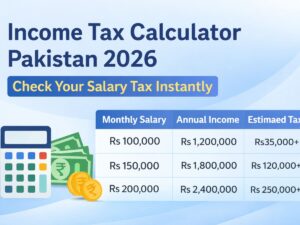
Want to understand your exact tax liability before filing? Use the free Income Tax Calculator Pakistan 2026 to estimate your dues instantly.
How the FBR Tax System Works in Pakistan
The Federal Board of Revenue (FBR) is the apex body responsible for tax collection and enforcement in Pakistan. It operates under the Ministry of Finance and administers key legislation including the Income Tax Ordinance 2001, the Sales Tax Act 1990, and the Federal Excise Act 2005.
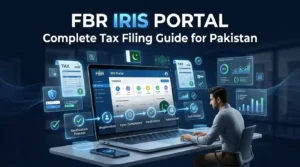
FBR manages all taxpayer data through its online tax portal called IRIS (Integrated Revenue Information System). The IRIS portal is where you register for an NTN, file income tax returns, submit wealth statements, and check your ATL status. Every taxpayer interaction — from e-enrollment to filing a nil return — happens through IRIS.
To understand the IRIS portal in depth, read: What Is FBR IRIS Portal? — a detailed breakdown for beginners.
FBR also manages the Active Taxpayer List (ATL), which is the official record of all individuals and entities that have filed their income tax returns for the latest tax year. Your ATL status directly affects the withholding tax rates applied to you by banks, property registrars, car dealers, and other withholding agents.
Step-by-Step Guide: How to Become an Active Tax Filer in Pakistan
Step 1 — Get Your NTN (National Tax Number)
Before you can file a tax return, you need an NTN. The NTN is your unique tax identity in Pakistan, similar to a national ID but for tax purposes.
Documents required for NTN registration:
- Original CNIC (Computerized National Identity Card)
- Active mobile number (linked to CNIC)
- Email address
- Utility bill of your residential address
- Bank account number (optional but recommended)
For business NTN registration, you’ll also need your business registration certificate, partnership deed (for AOPs), or incorporation certificate (for companies).
How to get NTN number in Pakistan online:
- Visit iris.fbr.gov.pk
- Click on “Registration for Unregistered Person”
- Enter your CNIC number and mobile number
- An OTP will be sent to your registered number
- Complete the e-enrollment form with your personal, address, and employment details
- Submit — your NTN is generated instantly online
You can also read the full guide here: How to Get NTN Number in Pakistan
For most salaried individuals, the NTN is the same as their CNIC number. Once enrolled, you receive login credentials for the IRIS portal.
Step 2 — Log In to the FBR IRIS Portal
Once you have your NTN and IRIS credentials, log in at iris.fbr.gov.pk. This is the central hub for all your tax-related activities in Pakistan.
Through the IRIS portal login, you can:
- File your income tax return (ITR)
- Submit a wealth statement
- Check your ATL status
- Pay taxes via CPR (Computerized Payment Receipt)
- Respond to FBR notices
- Update personal information
Having trouble accessing the portal? Read the detailed walkthrough: FBR IRIS Login Pakistan — Step-by-Step Guide
Step 3 — File Your Income Tax Return (Form 114)
The income tax return in Pakistan is filed using Form 114 on the IRIS portal. This form covers all sources of income including salary, business income, rental income, capital gains, agriculture income, and foreign remittances.
How to file income tax return on IRIS portal Pakistan:
- Log in to IRIS with your NTN and password
- Navigate to “Declaration” → “114(I) — Return of Income filed voluntarily”
- Select the relevant tax year (July 1 to June 30)
- Enter your total income from all sources
- Add deductions and exemptions (if applicable)
- Fill in the wealth statement (assets and liabilities)
- Pay any tax due via online banking and attach the CPR
- Submit the return
For salaried persons, your employer provides an annual salary certificate or tax deduction certificate (Form 16 equivalent), which you use to fill in the salary section of your return.
Filing a nil return? If your income is below the taxable threshold, you can still file a nil return to maintain your ATL status. Simply show zero income or income below the exemption limit and submit.
For a detailed walkthrough of the complete filing process, visit: How to File Income Tax Return in Pakistan
Also explore the comprehensive: Pakistan Tax Return Guide — covering every type of return from salaried to business to AOP.
Step 4 — Submit Your Wealth Statement
Along with the income tax return, filers in Pakistan are required to submit a Wealth Statement — a declaration of all assets and liabilities. This includes:
- Immovable property (plots, houses, commercial units)
- Vehicles
- Bank balances
- Investments and shares
- Foreign assets and remittances
- Loans and liabilities
First-time filers often worry about this step, but it is straightforward. You declare what you currently own, regardless of when you acquired it. In subsequent years, you explain the increase or decrease through reconciliation.
Step 5 — Check Your Active Taxpayer List (ATL) Status
After filing your return, your name appears on the ATL within a few days. You can verify your ATL status in three ways:
Method 1 — SMS: Send your CNIC number to 9966 (e.g., “ATL 3420112345678”)
Method 2 — Online Verification: Visit fbr.gov.pk → Taxpayer Facilitation → Active Taxpayer List → Enter CNIC/NTN
Method 3 — IRIS Portal: Log in and check your profile status directly
The ATL is updated every Sunday, so if you filed recently, wait a few days and check again. Once your name appears, you are officially an active tax filer in Pakistan.
Income Tax Slabs in Pakistan 2025–26
Understanding how FBR calculates income tax helps you file more accurately and plan your finances better. For salaried persons, Pakistan follows a progressive tax slab system.
For the latest salaried person tax rates, visit: Income Tax Slabs Pakistan — Salaried Person
Use the Business Tax Calculator Pakistan if you’re a business owner or self-employed professional.
Difference Between EFBR and IRIS Portal
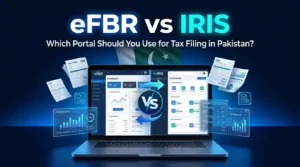
Many people confuse EFBR with IRIS. The old EFBR (electronic FBR) system has been replaced by the newer, more capable IRIS portal. All income tax return filing, NTN registration, and wealth statement submissions now happen exclusively through IRIS.
Read the full comparison: EFBR vs IRIS Tax Portal Pakistan
What Happens If You Don’t File Tax Return in Pakistan?
The consequences of remaining a non-filer go beyond just higher withholding tax rates. FBR has significantly increased enforcement under the Income Tax Ordinance 2001, and the penalties are real.
Penalties for non-filers in Pakistan:
- Higher tax deductions on every banking transaction, vehicle purchase, and property transfer
- Penalty under Section 182 for late filing (can be PKR 40,000 or more for high-income earners)
- FBR can issue best judgment assessment if returns are not filed
- FBR tax notices and audit risk increase significantly for non-filers
- Difficulty obtaining government contracts, work permits, and foreign remittances
Even if you’re a student, freelancer, or housewife with minimal income, filing a nil or low-income tax return keeps you protected and compliant.
Who Needs to File a Tax Return in Pakistan?
Under the Income Tax Ordinance 2001, the following people are required to file income tax returns:
- Every person whose taxable income exceeds the minimum threshold
- Owners of immovable property with an area of 500 sq. yards or more
- Owners of a flat with a covered area of 2,000 sq. feet or more
- Owners of a vehicle with an engine capacity of 1,000cc or above
- Persons who have a commercial or industrial electricity connection (above specified units)
- Registered members of a professional body (e.g., ICAP, ICMAP, PBC, PEC)
- Any person who has obtained NTN or registered for sales tax
Even if you fall outside this list, voluntarily filing ensures you enjoy filer benefits year-round.
Sales Tax Registration in Pakistan
If you run a business with annual turnover exceeding PKR 10 million, you are required to register for Sales Tax with FBR. Sales tax registration is separate from income tax registration and is done through the same IRIS portal.
After sales tax registration, you receive a STRN (Sales Tax Registration Number) and must file monthly sales tax returns. Understanding the Sales Tax Act 1990 and withholding rules is critical for businesses operating in Pakistan.
For comprehensive help with sales tax compliance, explore the Tax Consultant Course in Islamabad — FBR IRIS Guide.
Learn Taxation Professionally: Why ETTC Is Pakistan’s Leading Tax Training Institute
Understanding the FBR system, IRIS portal, income tax ordinance, and sales tax rules on your own takes months of self-study. That’s where Elite Tax Training Center (ETTC) comes in — Pakistan’s most trusted and results-driven taxation institute.
ETTC offers professional taxation courses in Islamabad, Karachi, Lahore, and Rawalpindi, with both in-person and online options, making quality tax education accessible across the country — from Faisalabad and Peshawar to Multan, Hyderabad, Sialkot, and Gujranwala.
What Makes ETTC the Best Taxation Institute in Pakistan?
1. Industry-Expert Instructors ETTC’s faculty includes practicing tax consultants, FBR-experienced professionals, and certified advisors who bring real-world case studies into every session. Learn from Chaudhry Hassan, Syed Baqir Raza, and Muhammad Ali — some of Pakistan’s most respected tax practitioners.
Meet the full ETTC Mentor Team who guide students through every aspect of Pakistan’s tax system.
2. Practical IRIS Training At ETTC, you don’t just read about the IRIS portal — you use it. Live demonstrations of NTN registration, income tax return filing, wealth statement submission, and ATL verification are part of every course. This hands-on IRIS training is what separates ETTC graduates from textbook learners.
3. Certified Tax Advisor Course ETTC’s flagship Certified Tax Advisor Course in Pakistan is designed for individuals who want to build a professional career in taxation. It covers income tax, sales tax, withholding tax, corporate tax filing, FBR procedures, and practical filing on IRIS — all in one structured program.
4. Multiple Course Options Whether you’re a student, salaried employee, business owner, or aspiring tax consultant, ETTC has a course for you:
- Tax Consultant Course in Islamabad
- UAE Tax Course in Pakistan
- UK Taxation Course in Pakistan
- USA Tax Course in Pakistan
- Browse All Courses at ETTC
5. Government-Recognized Certification ETTC provides certification recognized by industry bodies, making your credential credible for employment, freelance consulting, and business compliance work.
6. Location and Accessibility ETTC’s primary campus is conveniently located in Islamabad, with online programs reaching students in every major city. Whether you’re searching for a taxation course in Karachi, tax training institute Lahore, or taxation academy Islamabad, ETTC delivers the same high standard.
Learn more about ETTC and why thousands of students across Pakistan trust it for their taxation education.
Career Scope After Taxation Course in Pakistan
Completing a professional taxation course from ETTC opens multiple high-income career paths:
- Tax Consultant — serve individual and corporate clients for return filing, compliance, and planning
- Tax Manager at manufacturing, trading, or service companies
- FBR Officer (through CSS/competitive exams with a strong tax background)
- Freelance Tax Advisor — handle clients remotely across Pakistan and abroad
- Accounts and Finance roles — most finance jobs now require tax compliance knowledge
- International Tax Advisor — ETTC’s UAE, UK, and USA tax courses prepare you for global opportunities
The demand for qualified tax professionals in Pakistan is growing rapidly. With FBR digitizing enforcement, every business now needs someone who understands the IRIS portal, withholding tax rules, and compliance requirements. A certified tax advisor with IRIS training is one of the most in-demand professionals in Pakistan’s job market today.
Frequently Asked Questions (FAQs)
Q1: How to become a tax filer in Pakistan step by step? Register on the FBR IRIS portal using your CNIC to get an NTN. Then log in to IRIS, select the income tax return (Form 114), fill in your income and wealth details, pay any due tax, and submit. Your name will appear on the Active Taxpayer List (ATL) within a few days after filing.
Q2: What is the Active Taxpayer List (ATL) in Pakistan? The ATL is FBR’s official list of individuals and entities who have filed their income tax return for the most recent tax year. Being on the ATL entitles you to reduced withholding tax rates across banking, property, and vehicle transactions. It is updated every Sunday at fbr.gov.pk.
Q3: How to check if I am a tax filer in Pakistan? Send your CNIC number via SMS to 9966 (e.g., “ATL 3420112345678”). You can also check online at fbr.gov.pk under the Active Taxpayer List section, or log into your IRIS account to verify your status.
Q4: What is the deadline for filing a tax return in Pakistan? The standard deadline for individual income tax returns is September 30 of each year, covering income earned from July 1 to June 30 of the preceding tax year. FBR occasionally extends this deadline — check the FBR IRIS Portal Guide for the latest updates.
Q5: Can a student become a tax filer in Pakistan? Yes, absolutely. Any person with a CNIC can register on IRIS and file a nil tax return (showing zero or minimal income). Students benefit from filer status through reduced withholding taxes on transactions, and it builds good financial habits early.
Q6: What documents are required to file a tax return in Pakistan? You need your CNIC, NTN login credentials, salary certificate or business income details, bank statements, property and vehicle information for the wealth statement, and a CPR (payment receipt) if tax is due. For salaried persons, the employer’s tax deduction certificate simplifies the process significantly.
Q7: Is a taxation course worth it in Pakistan? Absolutely. With FBR increasingly digitising and enforcing compliance, businesses and individuals urgently need qualified tax professionals. A taxation certification from ETTC can lead to a high-income career as a tax consultant, advisor, or corporate tax manager — with starting salaries ranging from PKR 60,000 to PKR 150,000+, depending on specialisation and experience.
Q8: Which is the best taxation institute in Pakistan? Elite Tax Training Centre (ETTC) is consistently regarded as one of the top taxation academies in Pakistan, offering practical IRIS training, expert faculty, certified tax advisor programs, and courses covering Pakistan, UAE, UK, and USA taxation systems.
Conclusion: Your Next Step Toward Tax Compliance and Career Growth
Becoming an active tax filer in Pakistan is not complicated — it is a straightforward, fully online process that takes less than an hour once you know the steps. From getting your NTN and logging into the IRIS portal to filing your income tax return and checking your ATL status, every part of the process is digital, accessible, and free.
More importantly, filer status protects your money through reduced withholding tax rates, protects your business through legal compliance, and opens doors that remain closed to non-filers.
And if you want to go beyond just filing your own return — if you want to build a career helping businesses and individuals navigate Pakistan’s tax system — professional training from a trusted institute like ETTC gives you the practical skills, IRIS experience, and certification that employers and clients are looking for.
Ready to take the next step?
📌 Book Your Seat in the Advanced Taxation Course at ETTC — and start your journey toward becoming a certified, confident tax professional in Pakistan.
📌 Have questions? Contact ETTC Today — our team is ready to guide you.
📌 Explore all Tax Blogs and Resources at ETTC to keep learning for free.
For more tax insights and guides, visit the ETTC Official Website — Pakistan’s leading taxation training centre.