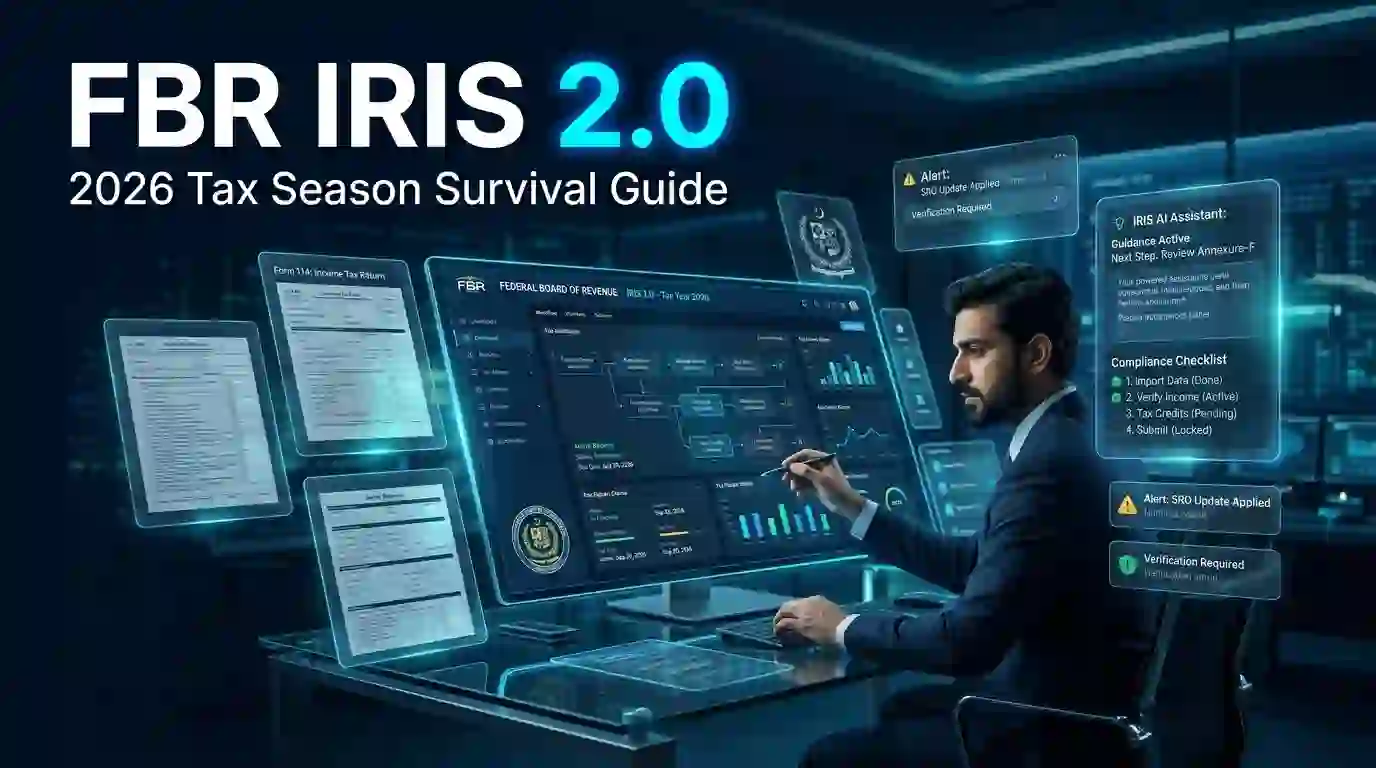
If you’ve ever stared at the FBR IRIS portal and felt like you were decoding a foreign language — you’re not alone. Thousands of taxpayers, accountants, and business owners across Pakistan face the same frustration every year. But here’s the good news: IRIS 2.0 has changed the game, and if you know how to use it, the 2026 tax season doesn’t have to be a nightmare. This guide walks you through everything — what IRIS 2.0 is, how it works, what’s new, and how you can master it before the September 2026 deadline hits.
What Is FBR IRIS 2.0? (And Why It’s Different This Time)
FBR IRIS 2.0 is the upgraded version of the Federal Board of Revenue’s Integrated Revenue Information System — Pakistan’s primary tax filing and compliance portal, developed and maintained by PRAL (Pakistan Revenue Automation Limited). Think of it as the government’s digital tax office, now faster, smarter, and — finally — more user-friendly.
The original IRIS portal launched years ago and served its purpose, but it was clunky, error-prone, and, frankly, intimidating for anyone without a formal background in taxation. IRIS 2.0 changes that. The new system comes with a revamped dashboard, improved navigation, faster data processing, and better integration with third-party systems.
If you want a deep technical walkthrough, the ETTC team has already published a dedicated breakdown at What Is the FBR IRIS Portal? — It’s worth bookmarking before you log in for the first time.
Key Features of IRIS 2.0 in the 2026 Tax Season
Here’s what’s actually new and different in IRIS 2.0 — and why these features matter for real taxpayers:
1. Single-Sign Dashboard You can now access income tax returns, sales tax registration, NTN management, wealth statements, and e-payments from one unified dashboard. No more jumping between tabs and sub-portals.
2. Pre-Filled Return Data IRIS 2.0 now pulls salary data, bank deductions, and withholding tax deductions directly from third-party integrations (employers, banks, utilities). This reduces manual entry errors massively.
3. Real-Time ATL Status Updates You can check your Active Taxpayer List (ATL) status in real time — no more waiting 24–48 hours for the system to refresh.
4. Smart Notices and Compliance Alerts The portal now sends automatic FBR tax notices and compliance alerts through email and SMS before deadlines hit, which significantly reduces the risk of penalties.
5. Improved Mobile Accessibility The new IRIS 2.0 interface is fully mobile-responsive, meaning you can file returns, make e-payments, and verify documents directly from your smartphone using the Tax Asaan app or the IRIS web portal.
For a step-by-step comparison of the old eFBR portal versus IRIS 2.0, check out this detailed comparison: eFBR vs IRIS Tax Portal Pakistan.
How to Register and Log In to FBR IRIS 2.0
Whether you’re a first-time filer or someone updating their credentials, registration on IRIS 2.0 is your starting point.
Step 1 — Get Your NTN. Before anything else, you need a National Tax Number (NTN). This is your unique tax identity in Pakistan. The process is fully online. Learn exactly how to do it here: How to Get an NTN Number in Pakistan.
Step 2 — Visit iris.fbr.gov.pk. Go to the official IRIS portal. Click “Registration for Unregistered Person” if you’re new. If you already have credentials, use the standard IRIS login page. Our detailed login guide is here: FBR IRIS Login Pakistan.
Step 3 — Complete Your e-Enrollment Fill in your CNIC, contact details, business or employment information, and upload required documents. You’ll receive a verification code on your registered mobile number.
Step 4 — Set Up Your Profile Once logged in, complete your taxpayer profile — add your bank accounts, property details, and business information. This sets the foundation for accurate return filing.
Documents typically needed for NTN registration include:
- Computerized National Identity Card (CNIC)
- Active mobile number
- Utility bill (for business address)
- Bank account details
- Business registration certificate (if applicable)
Filing Your Income Tax Return on IRIS 2.0 — Step by Step
This is where most people get stuck. But with IRIS 2.0, the process is genuinely more structured than before.
Step 1 — Log in to iris.fbr.gov.pk. Use your registered CNIC/NTN and password.
Step 2 — Select the Relevant Tax Year. For the 2026 tax season, you’ll be filing the return for the Tax Year 2025 (July 2024 – June 2025). Select this from the dropdown.
Step 3 — Choose Return Type: Are you filing as a salaried person, business owner, AOP (Association of Persons), or a company? Select accordingly. Each category has a different return form.
Step 4 — Enter Income Details. Input your total income from salary, business, property, capital gains, or other sources. IRIS 2.0 may pre-fill some data — always verify before submitting.
Step 5 — Add Deductions and Tax Credits. This is where most taxpayers lose money. You can claim deductions on:
- Tuition fee for children
- Charitable donations
- Health insurance premiums
- Investment in pension funds
- Profit on debt (for homebuyers)
Step 6 — Attach Wealth Statement. Every filer must submit a wealth statement showing assets and liabilities. Skipping this is one of the most common reasons for FBR audit notices.
Step 7 — Submit and Pay Any Outstanding Tax. If tax is payable, generate a PSID and pay via the FBR e-payment system or through your bank. Save your CPR (Computerized Payment Receipt).
Step 8 — Download Your Acknowledgement Slip. This is your proof of filing. Keep it saved in both digital and physical form.
For a full illustrated walkthrough, read: How to File Income Tax Return in Pakistan.
Income Tax Slabs for Salaried Persons in Pakistan — 2026
One of the most searched questions every year is: what are the income tax slabs for salaried persons in Pakistan?
Here’s a simplified summary for Tax Year 2025-26 based on the Finance Act 2026:
| Annual Income | Tax Rate |
|---|---|
| Up to Rs. 600,000 | 0% |
| Rs. 600,001 – Rs. 1,200,000 | 5% |
| Rs. 1,200,001 – Rs. 2,200,000 | 15% |
| Rs. 2,200,001 – Rs. 3,200,000 | 25% |
| Rs. 3,200,001 – Rs. 4,100,000 | 30% |
| Above Rs. 4,100,000 | 35% |
Note: Super tax may apply to high-income individuals and companies depending on applicable provisions of the Income Tax Ordinance 2001. Always verify the latest slabs using the Income Tax Calculator Pakistan 2026 before filing.
For a detailed slab breakdown: Income Tax Slabs Pakistan — Salaried Person.
The Danger Zones: Common IRIS 2.0 Mistakes That Trigger FBR Notices
Thousands of taxpayers file returns and still end up receiving FBR tax notices. Here’s why — and how to avoid it:
Mistake 1 — Incomplete Wealth Statement Missing assets, even small ones like a car or a savings account, trigger automatic red flags in the system.
Mistake 2 — Mismatch Between Income and Deductions If your claimed deductions don’t match third-party data (bank records, EOBI, salary certificates), the system flags your return.
Mistake 3 — Wrong Return Type Selected Filing as salaried when you also have freelance or rental income creates a mismatch that often leads to audit notices.
Mistake 4 — Skipping Section 149 or Section 153 Reconciliation Withholding tax deducted under Section 149 (salary) or Section 153 (contracts/services) must reconcile with what you declare. Discrepancies are one of the leading triggers for FBR correspondence.
Mistake 5 — Late Filing Without Extension The standard tax return deadline in Pakistan is September 30 each year. Missing it without an approved extension results in a Rs. 1,000 per day penalty plus disqualification from the Active Taxpayer List.
If you’ve already received a notice, don’t panic. A structured response within the given timeframe is key. Our team at ETTC has helped hundreds of clients navigate FBR audit situations through professional Tax Consultant Courses in Islamabad.
How to Check Active Taxpayer Status on IRIS 2.0
Being on the Active Taxpayer List (ATL) gives you significant financial advantages in Pakistan — lower withholding tax rates on property transactions, vehicle registration, banking transactions, and more.
To check your ATL status:
- Visit iris.fbr.gov.pk
- Click “Online Verification” from the top menu
- Select “Active Taxpayer List (Income Tax)”
- Enter your CNIC or NTN
- Hit Search — your status appears instantly
You can also send your CNIC number via SMS to 9966 to receive your ATL status via text.
For a complete guide on becoming and staying an active filer: How to Become an Active Tax Filer in Pakistan.
What Is Withholding Tax in Pakistan? (And Why It Concerns You More Than You Think)
Withholding tax is one of the most misunderstood concepts in Pakistani taxation — and one of the most financially significant for ordinary people.
It’s essentially a tax deduction at source. Before you receive income, a portion is already deducted by the payer and deposited with FBR on your behalf. It applies to:
- Salary income (Section 149)
- Bank profit and savings returns
- Property purchases and sales
- Cash withdrawals above Rs. 50,000 from non-filer accounts
- Services and contracts (Section 153)
- Import and export transactions
For non-filers, these withholding rates are significantly higher — sometimes double. That’s the real cost of not being on the ATL. Registering and filing returns isn’t just a legal obligation; it’s a direct financial saving.
Why Professionals Need a Proper FBR IRIS 2.0 Training Course
Here’s the reality no one talks about enough: filing a return incorrectly is often worse than not filing at all. A wrongly filed return creates a paper trail that can haunt you during audits, property transactions, and loan applications.
This is exactly why professional taxation courses in Pakistan have seen explosive demand in 2025 and 2026. Whether you’re:
- A fresh graduate entering the accounting profession
- A business owner wanting to understand your own taxes
- An accountant seeking practical IRIS 2.0 skills
- A lawyer expanding into tax advisory
- A freelancer managing cross-border income
…structured FBR IRIS 2.0 training gives you the hands-on competency that self-study and YouTube tutorials simply cannot.
ETTC (Elite Tax Training Center) is currently Pakistan’s most recognized practical taxation training institute, with courses designed specifically around the FBR IRIS 2.0 portal, the Income Tax Ordinance 2001, the Sales Tax Act 1990, and the Finance Act 2026.
Why Choose ETTC for Your Taxation Course in Pakistan?
ETTC isn’t a general accounting institute that throws in a few tax modules. It is purpose-built around one goal: creating job-ready, FBR-literate tax professionals who can handle real-world compliance from day one.
Here’s what sets ETTC apart:
Practical-First Curriculum Every module is built around live IRIS 2.0 portal exercises. You don’t just learn theory — you log in, file, and troubleshoot in real time under expert supervision.
Expert Mentors With Real FBR Experience ETTC’s mentors are not just academics. They are practicing tax consultants, chartered accountants, and FBR-registered professionals. Meet the ETTC team: Our Mentors at ETTC.
Location-Flexible Learning Whether you’re in Islamabad, Rawalpindi, Karachi, Lahore, or a smaller city like Faisalabad or Sialkot, ETTC offers both in-person classes and online FBR taxation courses that fit your schedule. Weekend batches and evening tax classes in Islamabad are available for working professionals.
Recognized Certification ETTC’s taxation certification is recognized by employers, FBR-registered firms, and corporate accounting departments across Pakistan. For fresh graduates especially, it’s the credential that opens doors.
Courses Covering Every Tax Domain From beginner income tax courses to advanced corporate taxation, GST filing, AOP returns, international tax (UAE, UK, USA), and wealth statement management — ETTC covers the complete spectrum. Explore all programs: Our Courses at ETTC.
You can also explore specialized international programs:
The Scope of Taxation in Pakistan — Career Opportunities in 2026
Pakistan has a massive tax gap problem. Millions of businesses and individuals remain outside the tax net. The government’s push toward digitization through IRIS 2.0, SIM blocking for non-filers, and enhanced enforcement means demand for qualified tax professionals has never been higher.
Career paths in taxation in Pakistan include:
- Tax Consultant / Advisor — Independent practice advising businesses and individuals on FBR compliance
- In-House Tax Manager — Corporate tax management for large companies (SECP-registered entities)
- FBR Officer Aspirant — IRIS 2.0 knowledge is essential for competitive FBR jobs and inland revenue department positions
- Accounting Firm Tax Specialist — Working within chartered accountant or ICMA-affiliated firms
- International Tax Advisor — Growing rapidly with UAE, UK, and US client bases served from Pakistan
- Tax Educator / Trainer — Teaching FBR compliance to businesses and professionals
According to the Pakistan Tax Bar Association, there are currently more than 3 million registered taxpayers with active NTNs, yet only a fraction receive proper advisory services. The demand-supply gap is enormous — and it’s your opportunity.
For a broader read on Pakistan’s tax landscape, the FBR Pakistan official website and the World Bank’s Doing Business reports are authoritative references on the country’s taxation trajectory.
Taxation Courses Available Across Pakistan — City-by-City
ETTC and other recognized institutes now offer taxation training across major Pakistani cities. Here’s a quick overview of what’s available where:
Islamabad / Rawalpindi The capital region has the highest concentration of FBR offices, corporate headquarters, and government entities. Tax courses in Islamabad — especially around Blue Area and I-8 — are in high demand. ETTC’s primary campus is in Islamabad. Contact: Tax Training Institute Islamabad.
Karachi Pakistan’s commercial hub. Tax institute Karachi programs focus heavily on corporate tax, import/export withholding, and SITE area business compliance.
Lahore Strong demand for tax training in Gulberg and DHA areas, particularly for manufacturing sector firms and accounting firms serving SMEs.
Other Cities Growing demand for tax courses in Faisalabad (textile sector), Multan (agriculture sector taxation), Peshawar, Quetta, Sialkot, Gujranwala, and Hyderabad — reflecting Pakistan’s broader economic formalization push.
Pakistan Tax Return Guide for 2026 — Quick Reference
Here’s a fast-access reference for the 2026 tax filing season:
- Filing Deadline: September 30, 2026 (for individuals and AOPs)
- Portal: iris.fbr.gov.pk
- Tax Year Covered: July 1, 2024 – June 30, 2025
- NTN Required: Yes — register first if you don’t have one
- Wealth Statement: Mandatory for all filers
- ATL Surcharge (if late): Rs. 20,000 for companies, Rs. 1,000 for individuals
- Penalty for Non-Filing: Rs. 1,000 per day
Read the complete return filing guide: Pakistan Tax Return Guide.
Frequently Asked Questions About FBR IRIS 2.0 and Taxation in Pakistan
What is FBR IRIS 2.0? FBR IRIS 2.0 is the upgraded version of Pakistan’s Federal Board of Revenue tax filing portal, developed by PRAL. It allows taxpayers to register, file income tax and sales tax returns, manage NTN records, submit wealth statements, and make e-payments — all from one integrated system.
What is the last date for tax return filing in Pakistan 2026? The standard deadline for filing income tax returns for Tax Year 2025 is September 30, 2026. Late filing results in penalties and removal from the Active Taxpayer List.
What documents are needed for NTN registration in Pakistan? You need your CNIC, a registered mobile number, a utility bill for your address, bank account details, and — if applicable — your business registration certificate. The process is fully online through iris.fbr.gov.pk.
What is the difference between NTN and STRN? NTN (National Tax Number) is your income tax registration identifier. STRN (Sales Tax Registration Number) is issued separately when you register for sales tax — it’s required for businesses supplying taxable goods or services and filing GST returns.
Is there a penalty for late tax filing in Pakistan? Yes. The FBR imposes a penalty of Rs. 1,000 per day for late income tax return filing, plus a surcharge of Rs. 1,000 (individuals) or Rs. 20,000 (companies) to be reinstated on the Active Taxpayer List.
How long does a taxation course take in Pakistan? Short courses at institutes like ETTC typically run 4 to 12 weeks, depending on the depth of coverage. The Certified Tax Advisor course covers FBR IRIS 2.0, income tax, sales tax, withholding tax, and wealth statements in a structured program. See details: Certified Tax Advisor Course in Pakistan.
Can I learn FBR IRIS 2.0 online? Yes. ETTC and several recognized institutes offer online FBR taxation courses that cover IRIS 2.0 portal training, return filing, NTN registration, and compliance — accessible from anywhere in Pakistan.
How do I handle an FBR tax notice? First, don’t ignore it. Read the notice carefully to identify the section under which it was issued. Gather the relevant supporting documents. Respond through IRIS 2.0 under the “Correspondence” section within the given timeframe. For serious notices, consult a registered tax practitioner.
Conclusion — Don’t Let the 2026 Tax Season Catch You Off Guard
FBR IRIS 2.0 is the most significant upgrade to Pakistan’s tax infrastructure in years. It’s faster, smarter, and more automated than anything that came before it. But it still rewards those who understand how it works — and penalizes those who don’t.
Whether you’re an individual filer trying to stay on the Active Taxpayer List, a business owner managing withholding obligations, or a professional building a career in taxation, the knowledge gap between where you are and where you need to be is closeable. It just takes the right training.
Elite Tax Training Center (ETTC) has helped hundreds of students, accountants, lawyers, and business owners across Pakistan master the FBR IRIS 2.0 system, navigate the Income Tax Ordinance 2001, and build real careers in taxation.
Book a seat in the Advanced Taxation Course at ETTC today — before the 2026 deadline season hits its peak.
Apply Now at ETTC | Explore All Courses | About ETTC | Contact Us