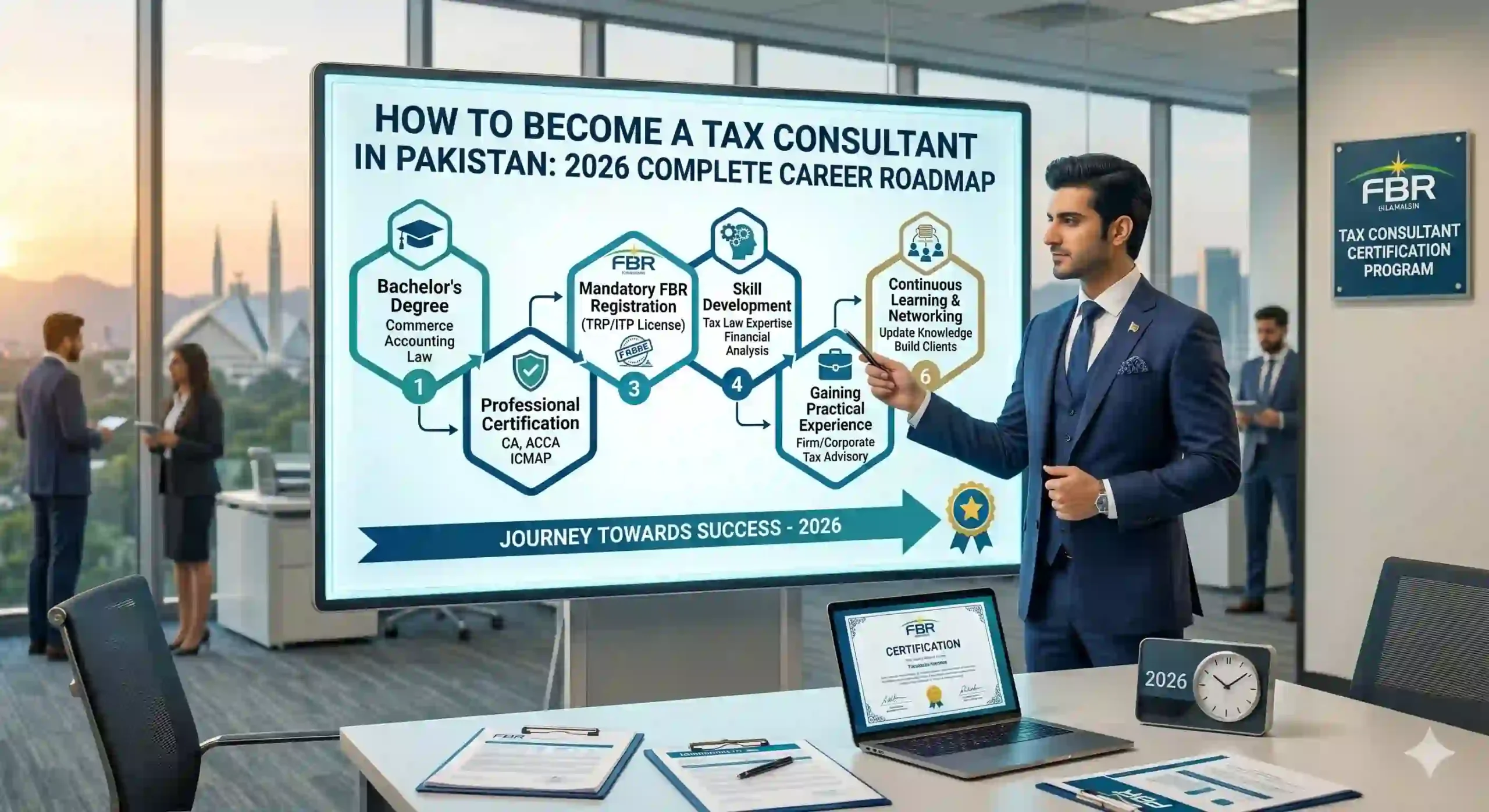
If you have ever wondered how to become a tax consultant in Pakistan and build a stable, well-paying career — you are in the right place.
Pakistan’s tax ecosystem is growing fast. The Federal Board of Revenue (FBR) is aggressively expanding the taxpayer base, introducing digital systems like the IRIS portal, and cracking down on non-compliance. This means one thing for professionals: the demand for skilled, certified tax consultants has never been higher.
Whether you are a fresh graduate, a working accountant, or a businessman looking to upskill — this guide walks you through every step of the career roadmap, from choosing the right taxation course in Pakistan to getting your FBR tax practitioner license and building a successful practice.
Let’s get into it.
What Does a Tax Consultant Actually Do in Pakistan?
Before diving into the roadmap, it helps to understand what this career actually looks like on a daily basis.
A tax consultant in Pakistan helps individuals, businesses, and corporations manage their tax obligations legally and efficiently. Their core responsibilities include:
- Filing income tax returns on IRIS FBR portal
- Preparing and submitting monthly sales tax returns
- Handling withholding tax statements under Section 165
- Responding to FBR tax notices and audit queries
- Advising clients on tax planning and compliance
- Registering businesses for NTN and STRN
- Representing clients before tax authorities
In short, a tax consultant is the bridge between a taxpayer and the Federal Board of Revenue. And with over 9 million active taxpayers now registered on the IRIS portal — and that number growing every year — the scope of this profession is enormous.
Is Taxation a Good Career in Pakistan?
Absolutely — and here is why.
Pakistan has one of the lowest tax-to-GDP ratios in the region, sitting around 9–10%. The government’s push to widen the tax net means millions of new filers are entering the system annually. Every one of those filers potentially needs a tax consultant.
On top of that, the launch of IRIS 2.0, FBR’s digital tax portal, has made e-filing mandatory for most taxpayers — but the system still has a steep learning curve for ordinary citizens. This gap between mandatory compliance and taxpayer knowledge is exactly where a skilled tax professional earns their value.
The scope of taxation in Pakistan covers:
- Individual income tax returns
- Corporate tax filings
- Sales tax and GST compliance
- Withholding tax management
- International taxation under double taxation agreements
- Provincial taxes via SRB, PRA, KPRA, and BRA
And the salary? A fresh tax consultant in Pakistan can earn PKR 40,000–70,000 per month in a firm. With experience and your own client base, earnings can cross PKR 200,000–500,000+ monthly. Freelance tax consultants with strong FBR knowledge are among the highest-earning financial professionals in the country right now.
Step-by-Step Roadmap: How to Become a Tax Consultant in Pakistan
Step 1 – Build the Right Educational Foundation
You do not need to be a chartered accountant to become a tax consultant. However, a relevant academic background does help. Common entry points include:
- B.Com / M.Com (Commerce)
- BBA / MBA (Finance or Accounting)
- CA, ACCA, ICMA (professional qualifications)
- Any bachelor’s degree combined with a professional taxation certification
Can a non-accountant become a tax consultant in Pakistan? Yes — a person from any educational background can enter this field by completing a recognized tax certification course and registering with FBR as a tax practitioner. Many successful tax consultants today started from non-finance backgrounds.
Step 2 – Enroll in a Professional Taxation Course in Pakistan
This is the most important step. No matter your background, you need hands-on, practical training in Pakistani taxation laws and the FBR IRIS system.
A quality taxation course in Pakistan should cover:
Income Tax:
- Income Tax Ordinance 2001 — all major sections
- Computation of taxable income (salary, business, property)
- Section 149 (income from salary), Section 153 (payments to residents), Section 147 (advance tax)
- Section 7E deemed income tax — one of the most discussed provisions in recent years
- Income tax return filing on IRIS
- Tax planning and exemptions
Sales Tax:
- Sales Tax Act 1990 and Finance Act amendments
- STRN registration process
- Input tax, output tax, and net payable calculation
- Monthly sales tax return filing
- Zero-rated vs exempt supplies
- FBR point of sale (POS) integration
Withholding Tax:
- Withholding agents and their obligations
- Monthly statements under Section 165
- Rates and applicability across different transactions
IRIS Portal & e-Filing:
- IRIS registration and login
- Submitting returns, statements, and annexures
- Responding to FBR notices online
- Checking ATL (Active Taxpayers List) status
Practical hands-on training on the IRIS portal is non-negotiable. Theory alone will not prepare you for real client work.
For the best taxation course in Pakistan with structured curriculum, practical IRIS training, and recognized certification, explore the Tax Consultant Course in Islamabad offered by ETTC — designed specifically for beginners, graduates, and professionals.
Step 3 – Get FBR Registered as a Tax Practitioner
After completing your taxation training, the next step is formal registration with the Federal Board of Revenue as an authorized tax practitioner.
What is FBR Tax Practitioner License?
FBR allows qualified individuals to register as “Tax Practitioners” — giving them the legal authority to represent clients before tax authorities, file returns on their behalf, and sign tax documents professionally.
How to register as a tax practitioner with FBR:
- Complete a recognized taxation qualification or course
- Log in to the IRIS portal at iris.fbr.gov.pk
- Navigate to the Registration section for Tax Practitioners
- Submit your academic credentials, CNIC, and course certificate
- Pay the applicable registration fee
- Receive your Tax Practitioner License upon approval
Understanding the FBR IRIS portal in Pakistan is essential before you begin this process — the entire registration happens online through the system.
Step 4 – Get Your NTN and Understand the Tax System Deeply
Before you can help others with their taxes, you must be in the system yourself.
How to get NTN number in Pakistan:
- Visit the IRIS portal: iris.fbr.gov.pk
- Click “Register for unregistered person”
- Enter your CNIC number
- Fill in personal and business details
- Submit and receive your NTN (National Tax Number) digitally
Your NTN is your identity as a taxpayer and as a tax professional. You should also understand STRN (Sales Tax Registration Number) registration for clients who need to be registered for sales tax.
For a complete guide, read How to Get NTN Number in Pakistan — it walks you through every step with screenshots and practical tips.
Step 5 – Choose a Specialization
The broader you start, the better — but as you grow, specializing increases your earning power significantly.
Popular specializations for tax consultants in Pakistan include:
Corporate Tax Specialist — Working with companies on corporate income tax, transfer pricing, and audit representation. High demand in Karachi and Islamabad’s corporate sector.
Sales Tax & GST Expert — Managing monthly returns, STRN registrations, and provincial taxes across SRB (Sindh), PRA (Punjab), KPRA (KPK), and BRA (Balochistan).
International Taxation — Advising on double taxation agreements, cross-border transactions, and OECD-compliant tax planning. Growing area as Pakistani professionals work globally.
UAE Tax Consultant — With the UAE’s introduction of corporate tax and VAT, Pakistani professionals in the UAE or businesses dealing with UAE entities need specialists in UAE tax for Pakistanis.
UK & US Taxation — For overseas Pakistanis and dual-income earners, knowledge of UK taxation or US tax laws opens an entirely different client market.
Step 6 – Gain Practical Experience
Certification and registration alone are not enough. You need real-world exposure to build confidence and credibility.
Ways to gain practical experience:
- Join a CA firm, tax consultancy, or accounting firm as a junior tax associate
- Intern at a corporate finance department
- Practice filing returns for family members or small businesses under supervision
- Assist a senior tax consultant with client work
- Take on small freelance cases through professional networks
The first 6–12 months of hands-on work will teach you more than any classroom. Learn to use IRIS end-to-end, handle client communication, and manage deadlines (especially September and December — the peak tax seasons in Pakistan).
Also bookmark resources like the Pakistan Tax Return Guide and How to File Income Tax Return in Pakistan — you will refer to these constantly in your early days.
Step 7 – Build Your Practice or Join a Firm
Once you have the skills, certification, and experience, you have two paths:
Option A — Join an Established Firm Firms in Karachi, Lahore, Islamabad, and Rawalpindi actively recruit certified tax consultants. Entry-level roles offer salary plus training. Larger firms also handle multinational clients, giving you exposure to international taxation.
Option B — Start Your Own Tax Consultancy This is where the real income potential lies. Starting a tax consultancy in Pakistan requires:
- FBR Tax Practitioner Registration (or working under one initially)
- A dedicated office or home-office setup
- IRIS access and relevant software
- A client acquisition strategy (referrals, LinkedIn, local business networks)
- Basic bookkeeping and practice management tools
Many successful consultants in cities like Rawalpindi, Faisalabad, Multan, and Peshawar started with 3–5 small business clients and scaled to 50+ clients within two to three years.
Which Certification Is Best for Tax Consultant in Pakistan?
There are several routes depending on your goals:
| Certification | Best For | Duration |
|---|---|---|
| Certified Tax Advisor (CTA) Course | Beginners and professionals | 3–6 months |
| Tax Consultant Course (ETTC) | Practical FBR training | 3 months |
| ACCA (Taxation Papers) | CA/ACCA students | Part of full program |
| ICAP Taxation Module | Chartered accountants | Part of CA program |
| ICMAP Taxation | Cost and management accountants | Part of ICMAP program |
For most professionals looking for the fastest route to becoming a practicing tax consultant in Pakistan, a dedicated Certified Tax Advisor Course in Pakistan from a reputable institute covers everything — income tax, sales tax, withholding tax, and IRIS training — in a structured timeline.
Taxation Courses Available Across Pakistan
Islamabad and Rawalpindi
The twin cities are home to Pakistan’s most active tax training ecosystem — largely because FBR headquarters is based in Islamabad. Students enrolling in taxation courses in Islamabad and tax courses in Rawalpindi benefit from proximity to the FBR facilitation center and access to instructors with direct FBR experience.
Elite Tax Training Center (ETTC) — based in Islamabad — is one of the most recognized names for professional tax training in the region. Their curriculum covers everything from basic income tax concepts to advanced corporate filing and IRIS 2.0 navigation.
Karachi
Taxation courses in Karachi are heavily focused on corporate tax and sales tax, given the city’s commercial dominance. Tax institutes in Karachi tend to offer both weekday and weekend batches to accommodate working professionals. Topics like SRB (Sindh Revenue Board) sales tax on services are covered extensively in Karachi-based courses.
Lahore
Tax training institutes in Lahore offer strong programs covering PRA (Punjab Revenue Authority) provincial sales tax, IRIS training Lahore, and income tax filing. The demand for tax consultants in Lahore’s SME sector makes this a lucrative market for newly certified professionals.
Other Cities
Quality taxation training is now accessible across Pakistan — including Faisalabad, Multan, Peshawar, Quetta, Sialkot, Gujranwala, Hyderabad, Bahawalpur, Sargodha, and Abbottabad. Online taxation courses with certificates have also made it possible for learners in smaller cities to access the same curriculum as major urban centers.
Understanding the Key Laws Every Tax Consultant Must Know
A tax consultant in Pakistan must have working knowledge of:
Income Tax Ordinance 2001 — The master legislation governing all income tax in Pakistan. Critical sections include salary taxation (Section 149), business income, capital gains, and advance tax (Section 147).
Sales Tax Act 1990 — Governs federal sales tax on goods. Covers registration, filing, input/output tax, exemptions, and penalties.
Federal Excise Act 2005 — Applies to specified goods and services subject to federal excise duty.
Finance Act (Annual) — Updated every budget year. A good tax consultant follows Finance Act amendments closely — rates, slabs, and provisions change annually.
Provincial Revenue Laws — SRB, PRA, KPRA, and BRA each have their own service tax laws. If your clients operate across provinces, you need to understand all four jurisdictions.
For a quick reference on income tax slabs and how they apply to salaried individuals, visit Income Tax Slabs Pakistan – Salaried Person.
What Software and Tools Do Tax Consultants Use in Pakistan?
IRIS Portal (iris.fbr.gov.pk) — The primary platform for all federal tax compliance. Returns, registrations, notices, and payments all happen here. Learn to navigate it inside out.
IRIS 2.0 — The upgraded version of the IRIS system. Check the IRIS 2.0 Survival Guide for Tax Season to stay ahead of the interface changes.
FBR eFBR vs IRIS comparison — Many professionals are confused about the difference between the older eFBR system and the current IRIS portal. Read eFBR vs IRIS Tax Portal Pakistan for a clear breakdown.
Sales Tax Returns — Filed monthly through IRIS. Understanding the annexures (A, B, C, H) is essential.
Income Tax Calculator — Use ETTC’s Income Tax Calculator Pakistan 2026 to quickly compute client liabilities.
Excel and Accounting Software — Most tax consultants maintain client records in Excel or accounting tools like QuickBooks and Intuit for bookkeeping purposes.
How to Become an Active Tax Filer in Pakistan
One of the first things clients ask you about is how to become an active filer on the ATL (Active Taxpayers List). As a tax consultant, you must know this process cold.
The complete process is covered in our guide: How to Become an Active Tax Filer in Pakistan — essential reading for any aspiring consultant.
Why Choose ETTC for Your Taxation Training?
Elite Tax Training Center (ETTC) is one of Pakistan’s leading tax training institutes, based in Islamabad, with students across Pakistan through both in-person and online batches.
What makes ETTC different:
- Industry practitioners as instructors — people who file real returns, handle real audits, and appear before real tax authorities
- Curriculum updated with every Finance Act — you learn what is current, not what was relevant three years ago
- Hands-on IRIS portal training — no theory-only classes
- Complete coverage of income tax, sales tax, withholding tax, provincial taxes, and FBR notices
- Certificate of completion recognized by employers and clients
- Morning, evening, and weekend batches available
- Online classes for students in Karachi, Lahore, Faisalabad, Peshawar, Multan, and other cities
ETTC’s Certified Tax Advisor Course is specifically designed to take a complete beginner to job-ready professional in one structured program.
Meet the expert mentors behind the curriculum on the Our Mentor page — professionals with decades of hands-on FBR and corporate tax experience.
Explore all available programs on the ETTC Courses page.
Frequently Asked Questions (FAQs)
How to become a tax consultant in Pakistan? Complete a professional taxation course covering income tax, sales tax, and IRIS portal training. Then register with FBR as a tax practitioner through the IRIS portal. Gain practical experience by filing returns and handling compliance for clients. With a recognized certification and FBR registration, you are ready to practice professionally.
What qualifications are needed to become a tax consultant in Pakistan? There is no single mandatory degree. However, a commerce or finance background helps. Most importantly, you need a recognized taxation certification — such as the Certified Tax Advisor (CTA) course — along with FBR tax practitioner registration. CA, ACCA, and ICMA qualifications also provide strong tax knowledge.
How long does it take to become a tax consultant? A dedicated taxation course in Pakistan typically runs 3 to 6 months. After completion and FBR registration, you can start taking clients. Most practitioners feel confident handling independent clients within 6–12 months of completing training and gaining practical experience.
What is the salary of a tax consultant in Pakistan? Entry-level tax consultants earn PKR 40,000–70,000 per month in firms. Experienced consultants with their own practice can earn PKR 200,000–500,000+ per month depending on the client base and specialization.
Can a non-accountant become a tax consultant in Pakistan? Yes. Any graduate — regardless of their field — can become a tax consultant by completing a professional taxation certification and registering with FBR. Many successful tax consultants have backgrounds in arts, science, engineering, and even medicine.
What is the IRIS portal used for in Pakistan? IRIS (Integrated Revenue Information System) is FBR’s official digital platform for all federal tax compliance. It is used for NTN registration, income tax return filing, sales tax return submission, withholding tax statements, and responding to FBR notices. Every tax consultant must master this system.
How much does a taxation course cost in Pakistan? Taxation course fees in Pakistan typically range from PKR 15,000 to PKR 60,000 depending on the institute, duration, and curriculum depth. Contact ETTC for current course fees and batch schedules.
What is the difference between a tax consultant and a tax advisor? In practice, both terms are often used interchangeably in Pakistan. A tax consultant typically handles compliance work — filing returns, managing registrations, responding to notices. A tax advisor focuses more on strategic tax planning — advising on legal structures, minimizing tax liabilities, and long-term financial planning. Senior professionals often perform both roles.
Career Opportunities After Becoming a Tax Consultant
The beauty of this career is how many doors it opens:
- Tax Consultant (Private Practice) — Build your own client base of individuals, SMEs, and corporations
- Tax Manager in a Corporate Firm — Handle in-house tax compliance for large companies
- FBR Officer — Government career through CSS/IRS exams (Income Tax Inspector)
- Tax Trainer or Educator — Teach at a tax institute or launch your own training business
- International Tax Specialist — Work with overseas Pakistanis or multinational companies
- Freelance Tax Consultant — Work remotely with clients across Pakistan or internationally
- Tax Blogger or YouTuber — Monetize your tax knowledge through content (growing rapidly)
Visit Tax Blogs Pakistan for insights on how tax professionals are building their authority and income through content creation.
Conclusion — Your Roadmap Starts Today
Becoming a tax consultant in Pakistan is one of the smartest career decisions you can make in 2026. The demand is real, the income potential is strong, and the profession is only growing as Pakistan’s tax ecosystem modernizes.
Here is your roadmap in brief:
- Build educational foundation (any relevant degree or background)
- Enroll in a professional taxation course in Pakistan
- Master the IRIS portal and FBR systems
- Register as a tax practitioner with FBR
- Get NTN and build your compliance knowledge
- Gain practical experience with real clients
- Choose a specialization and grow your practice
The one thing that separates tax consultants who succeed from those who struggle is quality training. Classroom-only knowledge is not enough — you need practical, system-based training from instructors who work in the field.
Ready to take the first step? Book a seat in the Advanced Taxation Course at Elite Tax Training Center (ETTC) — Pakistan’s leading tax training institute with hands-on IRIS training, expert mentors, and a curriculum built for the real world of Pakistani taxation.
Your tax career starts with one enrollment. Make it count.
For further reading, explore ETTC’s complete resource library: