Receiving an FBR (Federal Board of Revenue) tax notice can feel overwhelming for many Pakistani taxpayers and business owners. Whether you’re a salaried individual, self-employed professional, or business entity, understanding what these notices mean and how to respond properly is crucial for maintaining compliance with Pakistan’s taxation system. This comprehensive guide explains everything you need to know about FBR tax notices, the different types you might receive, their implications, and the correct procedures for responding effectively.
Tax notices are a normal part of the taxation system in Pakistan. The Federal Board of Revenue uses these notices to communicate with taxpayers, verify information, request documentation, or assess tax liability. Rather than viewing these notices with anxiety, it’s better to understand them as essential communication tools that help ensure proper tax compliance. In this article, we’ll break down the complexities of FBR tax notices, explain how the tax notice procedures work in Pakistan, and provide actionable steps for responding appropriately.
Understanding the taxation system in Pakistan is becoming increasingly important as FBR strengthens its enforcement mechanisms. Whether you’re managing your income tax, sales tax, or dealing with withholding tax matters, knowing how to respond to FBR notices can make a significant difference in your tax situation. For those looking to deepen their knowledge of Pakistani taxation procedures, consider exploring professional tax training programs and taxation certification courses available throughout Pakistan.
What is FBR Tax Notice? Understanding the Basics
An FBR tax notice is a formal communication from the Federal Board of Revenue (FBR) to taxpayers regarding their tax obligations, assessments, or compliance requirements. These notices serve as the primary method through which FBR maintains tax authority communication with individuals and businesses across Pakistan.
Key characteristics of FBR tax notices include:
- Official documentation bearing FBR letterhead and barcode verification
- Specific reference numbers for tracking and reference purposes
- Clear deadline for response or compliance
- Detailed explanation of requirements or findings
- Information about tax liability determination or assessment
- Instructions for payment or documentation submission
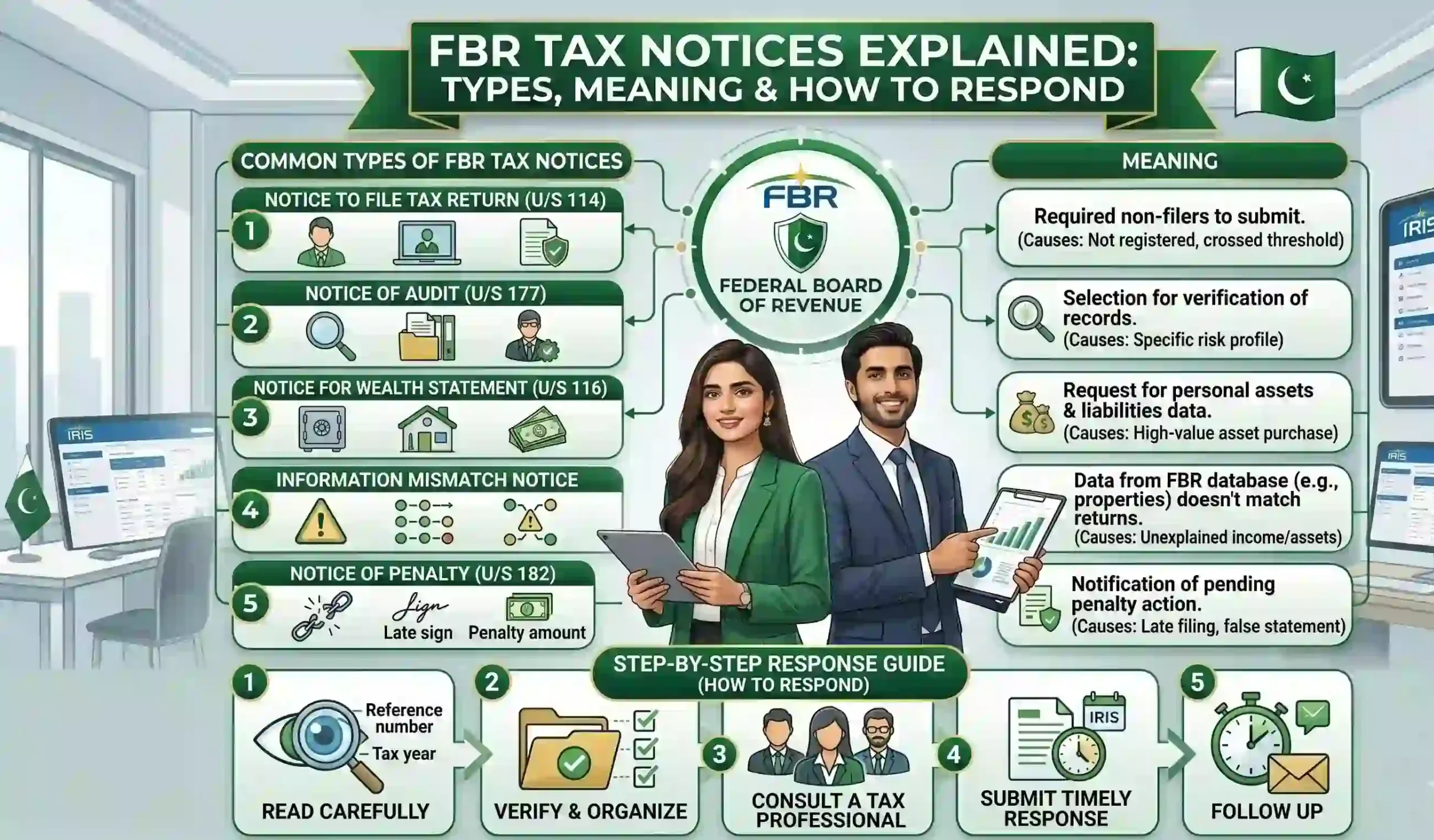
The FBR issues tax notices under various sections of the Income Tax Ordinance 2001 and the Sales Tax Act 1990. Each notice type has different legal implications and requires different response approaches. Understanding what type of notice you’ve received is the first critical step in responding appropriately.
Types of FBR Tax Notices Explained
1. Assessment Notice (Section 122 of Income Tax Ordinance 2001)
An FBR assessment notice is one of the most common types of notices issued to taxpayers. This notice indicates that FBR has completed an assessment of your tax liability based on the information submitted in your tax return or through other sources.
What it means:
- FBR has calculated your tax liability for a specific tax year
- The assessment is based on your declared income and applicable tax rates
- You’re being informed of the final tax amount due
- This is a regulatory tax notice that requires attention but can be appealed if you disagree
Action required:
- Review the assessment details carefully
- Verify calculations and income figures
- Pay the assessed amount by the deadline, or
- File an appeal if you believe the assessment is incorrect
2. Show Cause Notice (Section 114 of Income Tax Ordinance 2001)
A show cause notice from FBR is a more serious communication that requires taxpayers to explain or justify certain tax positions. This notice indicates that FBR has identified discrepancies or inconsistencies in your tax filing and wants you to provide an explanation.
What it means:
- FBR has identified potential tax compliance issues
- You’re required to provide documents and explanations
- The notice outlines specific concerns FBR wishes to address
- This is an opportunity to respond before formal assessment
Action required:
- Gather all relevant documentation mentioned in the notice
- Write a detailed, factual response explaining your tax position
- Submit supporting evidence within the specified deadline
- Consider seeking professional guidance from a tax consultant
3. Demand Notice
A demand notice represents FBR’s formal request for payment of outstanding tax dues. This notice is issued when a taxpayer has failed to pay assessed taxes within the prescribed period.
What it means:
- You have unpaid tax liability
- FBR is demanding immediate payment
- Penalties and interest may be accumulated
- Further legal action may follow non-compliance
Action required:
- Pay the demanded amount immediately
- If unable to pay in full, contact FBR to discuss payment arrangements
- Provide proof of payment by the deadline
4. Audit Notice (Section 177 of Income Tax Ordinance 2001)
An audit notice from FBR indicates that your tax return or business records have been selected for detailed examination. This is one of the most important types of regulatory tax notices as it can lead to significant reassessment.
What it means:
- Your financial records will be examined in detail
- FBR may request bank statements, invoices, and other documents
- The audit may result in adjustment to your tax liability
- This is a formal audit notice that requires comprehensive documentation
Action required:
- Organize all financial records chronologically
- Prepare documentation supporting income and expenses
- Schedule an appointment with the assigned audit officer
- Maintain professional communication throughout the process
5. Adjustment Notice
An FBR adjustment notice indicates that FBR has identified discrepancies in your tax filing and is making corrections to your tax liability.
What it means:
- Corrections are being made to your originally filed return
- Your tax liability is being adjusted upward or downward
- The notice explains the specific adjustments made
- This is a formal notification of changed tax assessment
Action required:
- Review the adjustments carefully
- Verify that corrections are accurate
- Pay any additional tax due, or
- File an appeal if you disagree
6. Default Notice (Section 214D of Income Tax Ordinance)
A default notice is issued when a taxpayer fails to comply with FBR’s previous notices or requirements, including failure to file returns on time.
What it means:
- You’ve failed to meet tax obligations
- Penalties for non-compliance are being imposed
- FBR is taking formal action against non-compliance
- Default notice consequences can be serious
Action required:
- Immediately comply with the original requirement
- Pay any penalties imposed
- File required documentation without further delay
- Understand the interest on tax that may accrue
7. Sales Tax Notice from FBR
A sales tax notice from FBR relates to general sales tax (GST) compliance. These notices address sales tax registration, filing, or payment issues.
What it means:
- There’s a sales tax compliance issue
- You may need to register or update your registration
- Sales tax filing or payment discrepancies have been identified
- This relates to indirect taxation obligations
Action required:
- Verify your sales tax registration status
- Ensure timely filing of sales tax returns
- Pay any outstanding sales tax dues
- Review sales tax pakistan requirements if unfamiliar
8. Withholding Tax Notice
A withholding tax notice addresses issues with taxes that should be withheld from payments to employees, contractors, or service providers.
What it means:
- Withholding tax has not been properly deducted or deposited
- FBR is addressing non-compliance with withholding requirements
- Penalties may apply for incorrect withholding
- This is a compliance matter requiring immediate attention
Action required:
- Review withholding tax procedures
- Calculate correct withholding amounts
- Deposit outstanding withholding tax immediately
- Implement proper procedures going forward
Why FBR Tax Notices Matter – Tax Compliance Pakistan
Proper understanding of FBR tax notices is essential for several reasons:
Legal Compliance: The Income Tax Ordinance 2001 and Sales Tax Act 1990 are legal frameworks that require taxpayer compliance. Ignoring FBR notices can result in legal consequences including fines, penalties, and potential criminal action.
Financial Protection: Understanding tax notices helps protect your financial interests. Many taxpayers overpay or accept incorrect assessments simply because they don’t understand the notice they received. Proper response can help you pay only what you legally owe.
Business Credibility: For business owners, maintaining good tax compliance status is crucial for:
- Obtaining banking facilities and loans
- Conducting business with government entities
- Maintaining supplier and customer relationships
- Protecting business reputation
Penalty Avoidance: Interest on tax and penalties accumulate quickly when notices are ignored. Prompt response often prevents these additional charges.
How to Respond to FBR Tax Notice – Step-by-Step Guide
Step 1: Carefully Read and Understand the Notice
The first step is to thoroughly review every detail of the notice you’ve received:
- Identify the notice type and relevant section of tax law
- Note the deadline for response
- Understand the specific issue FBR is addressing
- Review any calculations or figures presented
- Identify what documentation or information FBR is requesting
Step 2: Gather All Relevant Documentation
Different notices require different documentation:
For assessment notices: Tax return, bank statements, income receipts, expense invoices
For audit notices: Complete financial records, ledgers, invoices, bank statements, payment receipts
For show cause notices: Documents specifically mentioned in the notice, along with explanations
For demand notices: Proof of previous payments, if challenging the amount
Step 3: Write a Professional Response Letter
When writing your response, follow these guidelines:
- Use formal business letter format
- Address the letter to the appropriate FBR officer
- Reference the notice number and date
- Be clear, concise, and factual
- Avoid emotional language or accusations
- Support your position with documentation
- Keep the response organized and easy to follow
- Include your NTN (National Tax Number) and reference details
Sample response structure:
- Acknowledgment of the notice received
- Clear statement of your position
- Point-by-point response to FBR’s concerns
- Supporting documentation and references
- Request for consideration and next steps
Step 4: Organize and Submit Documentation
- Make copies of all supporting documents
- Arrange documents logically (chronologically or by category)
- Create a cover sheet listing all included documents
- Include a reference number for easy tracking
- Submit within the deadline specified in the notice
- Keep copies for your records
Step 5: Follow Up and Track Response
- Note the submission date and method
- Request acknowledgment of receipt if possible
- Follow up if you don’t receive response within reasonable timeframe
- Maintain records of all communications
- Document any subsequent notices or requests
Tax Notice Response Letter Pakistan – Best Practices
Writing an effective tax notice response letter Pakistan is a critical skill for taxpayers. Here are key best practices:
Be Specific and Factual: Rather than general statements, provide specific information addressing FBR’s concerns. For example, instead of saying “I reported all my income,” you might say “The Rs. 500,000 income shown in my tax return is from my consulting business as documented in invoices numbered 001-045 enclosed herein.”
Show Your Work: Include calculations, spreadsheets, and detailed breakdowns that support your position. Help FBR understand your tax position clearly.
Acknowledge Legitimate Concerns: If FBR has identified a legitimate compliance issue, acknowledge it and explain how you’ve corrected it. This demonstrates good faith and responsibility.
Use Professional Language: Maintain a respectful, professional tone throughout. Avoid confrontational language or accusations.
Include Clear References: Reference specific sections of tax law, regulations, or FBR circulars that support your position.
FBR Notice Deadline and Timeline – What You Need to Know
Understanding FBR notice deadlines is crucial for proper response:
Standard Response Period: Most FBR notices provide 14-30 days for response, though some may allow longer periods.
Assessment Notices: Typically allow 30 days to respond or pay the assessed amount.
Show Cause Notices: Usually provide 10-14 days for detailed response with documentation.
Audit Notices: May extend over several weeks as detailed records are reviewed.
Demand Notices: Require immediate payment, typically within 7-14 days.
Important reminder: Don’t interpret silence or lack of FBR response as approval. Continue following up and maintain documentation of all submissions.
FBR Tax Notice Penalties and Interest
One critical aspect of FBR tax notices is understanding the penalties and interest charges that may apply:
Interest on Tax:
- Accumulates monthly at rates determined by FBR
- Continues to increase until tax is paid
- Calculated on outstanding tax amount
Late Filing Penalties:
- Imposed for filing tax returns after the deadline
- Amount varies based on how late the filing is
- Can range from modest amounts to substantial penalties
Non-Compliance Penalties:
- Applied for ignoring FBR notices
- Can be 50% to 100% of the tax amount in some cases
- Increase with continued non-compliance
Audit-Related Penalties:
- May be assessed if significant discrepancies are found during audit
- Percentage depends on nature and extent of discrepancies
Appeal Against FBR Tax Notice – Understanding Your Rights
If you disagree with an FBR assessment or notice, you have the right to appeal. The tax appeal process in Pakistan involves several steps:
First Appeal:
- Filed with the Commissioner Inland Revenue (CIR) within 30 days of notice
- Detailed grounds of appeal must be provided
- Supporting documentation should be submitted
Second Appeal:
- Filed with the Appellate Tribunal Inland Revenue (ATIR)
- Only on points of law, if CIR’s decision is unsatisfactory
- Professional representation is recommended
Further Appeal:
- To the High Court on significant legal questions
- Rare and requires specific circumstances
For detailed guidance on the tax appeal procedure, it’s helpful to understand the complete process through professional tax training and guidance.
Taxation Courses in Pakistan – Building Your Tax Knowledge
For those dealing frequently with tax notices or interested in taxation as a profession, formal education in taxation is invaluable. Taxation courses in Pakistan have expanded significantly to meet the growing demand for tax professionals.
Why Pursue Taxation Training?
Professional Development: Build expertise in understanding Pakistani taxation system, FBR procedures, and compliance requirements.
Career Advancement: Tax consultants, tax advisors, and tax professionals are in high demand across Pakistan.
Better Personal Tax Management: Understanding taxation helps you manage your own taxes more effectively.
Business Growth: For business owners, taxation knowledge is essential for strategic planning.
Types of Taxation Courses Available
Income Tax Courses:
- Comprehensive coverage of Income Tax Ordinance 2001
- Practical application of tax rules and procedures
- Real-world case studies and problem-solving
Sales Tax Courses:
- General Sales Tax (GST) compliance and filing
- Sales tax registration and procedures
- Integration with other tax obligations
Professional Certification Programs:
- Certified Tax Advisor (CTA) courses
- Advanced taxation diplomas
- FBR-recognized qualifications
Specialized Courses:
- International taxation
- Corporate tax planning
- Tax audit and compliance
- Personal income tax management
Location-Specific Taxation Training
Taxation Courses in Islamabad
As Pakistan’s capital and administrative center, Islamabad hosts numerous institutions offering taxation courses. Taxation courses in Islamabad are particularly valuable given the presence of FBR headquarters and numerous tax-related organizations.
Elite Tax Training Center (ETTC) in Islamabad offers comprehensive taxation education including:
- Certified Tax Advisor Course in Pakistan – Industry-recognized certification
- Tax Consultant Course in Islamabad – Practical training for aspiring consultants
- Tax Consultant Course FBR IRIS Guide – Specialized FBR and IRIS portal training
- Taxation academy in Islamabad – Comprehensive taxation training programs
Taxation Training in Rawalpindi
Tax courses in Rawalpindi provide convenient access for residents of the twin cities of Rawalpindi and Islamabad. Professional tax training institutes in Rawalpindi offer flexible scheduling and practical, hands-on education.
Taxation Courses in Karachi
As Pakistan’s largest metropolitan area and commercial hub, Taxation courses in Karachi are abundant. The city’s business-focused environment makes tax education particularly relevant:
- Tax training institute Karachi
- Certified tax advisor Karachi programs
- Sales tax course Karachi
- Income tax course Karachi
Taxation Courses in Lahore
Tax training institute Lahore and other tax education providers in Pakistan’s second-largest city offer:
- Best tax courses Lahore
- Advanced taxation courses
- IRIS training Lahore programs
- Professional tax certification courses
Other Major Cities
Taxation training Peshawar, Taxation training Faisalabad, Tax institute Multan, and programs in other cities ensure that comprehensive tax education is available throughout Pakistan.
Understanding Key FBR Portals and Systems
Modern tax compliance in Pakistan involves understanding digital platforms:
IRIS (Institute of Revenue Internal Security)
The IRIS portal in Pakistan is FBR’s primary online platform for:
- Filing tax returns electronically
- Checking tax status and notices
- Verifying NTN and tax registration
- Submitting documents to FBR
eFBR System
The electronic FBR system complements IRIS for:
- Taxpayer registration
- Filing and amendment of returns
- Payment of taxes
- Communication with FBR
Related resources:
- FBR IRIS Portal – Complete Guide
- IRIS vs eFBR – Understanding the Difference
- FBR IRIS Login Pakistan
- FBR IRIS 2 Survival Guide Tax Season
Frequently Asked Questions About FBR Tax Notices
Q1: What should I do immediately after receiving an FBR tax notice?
A: First, carefully read and understand the notice completely. Note the deadline for response, identify the specific issue FBR is addressing, and gather relevant documentation. Don’t panic – FBR notices are standard tax administration procedures. If the notice is complex, consider consulting a tax professional. Begin organizing your response immediately to avoid missing deadlines.
Q2: How much time do I have to respond to an FBR tax notice?
A: Response periods vary by notice type. Most notices allow 14-30 days for response. Assessment notices typically allow 30 days, while show cause notices may allow 10-14 days. Always check your specific notice for the exact deadline. Never miss the deadline, as this can result in penalties and legal consequences.
Q3: What happens if I ignore an FBR tax notice?
A: Ignoring an FBR notice can have serious consequences including accumulation of interest and penalties, issuance of default notices, legal proceedings, and in extreme cases, criminal action. The interest on tax continues to accumulate, making your total liability increasingly expensive. It’s always better to respond, even if you disagree with the notice.
Q4: Can I appeal an FBR tax assessment that I disagree with?
A: Yes, absolutely. You have the right to appeal within 30 days of receiving an assessment notice. Appeals are filed with the Commissioner Inland Revenue (CIR), with further appeals possible to the Appellate Tribunal Inland Revenue (ATIR) and beyond. Professional representation during appeals is recommended.
Q5: How do I calculate the tax amount I owe on an FBR assessment notice?
A: The assessment notice should clearly show the calculation. However, verify the calculation by:
- Checking your reported income figures
- Verifying applicable tax rates and slabs for your income level
- Reviewing any deductions or exemptions claimed
- Ensuring correct calculation of total tax liability
If you find errors, include these in your response with corrected calculations.
Q6: What documents do I need for responding to an audit notice?
A: An audit notice typically requests comprehensive documentation including bank statements, business invoices and receipts, employee salary records, expense documentation, property purchase and sale documents, investment proofs, and any other documents relevant to the audit’s scope. Organize these chronologically and provide clear indexing for easy reference.
Q7: What is the difference between assessment notice and demand notice?
A: An assessment notice informs you of FBR’s calculated tax liability and allows opportunity for response or appeal. A demand notice is issued later if tax remains unpaid after the assessment deadline, requiring immediate payment. Demand notices are more serious and allow less flexibility.
Q8: How long does FBR take to resolve a tax notice?
A: Resolution timeframes vary significantly based on notice type and complexity. Simple matters may be resolved in weeks, while complex audits can take months or years. Providing complete documentation promptly helps expedite resolution.
Q9: What is a “default notice” and what are the consequences?
A: A default notice is issued when you fail to comply with previous FBR requirements. Consequences include penalties (potentially 50-100% of tax amount), accumulated interest, potential legal proceedings, and damage to your tax compliance record. Responding immediately to any FBR notice helps avoid default notices.
Q10: Should I hire a professional tax consultant for FBR notices?
A: For complex matters, especially audits, show cause notices, or appeals, professional guidance is highly recommended. Tax consultants understand FBR procedures, know how to present information persuasively, and can help protect your interests. For simpler notices, you may respond independently if you’re confident and organized.
Q11: What is an “active taxpayer” and why is it important?
A: An active taxpayer is someone who regularly files tax returns and maintains good compliance. Status affects your business credibility, ability to obtain loans, and FBR treatment. Learn how to become an active tax filer in Pakistan.
Q12: How do sales tax notices differ from income tax notices?
A: Sales tax notices address indirect taxation compliance (general sales tax filing and payment), while income tax notices address direct taxation (personal or corporate income). Both are important and both require timely response.
Practical Tips for Handling FBR Tax Notices Effectively
Maintain Organized Records: Keep financial records in good order from the start. Well-organized documentation makes responding to notices much easier and demonstrates professionalism to FBR.
Understand Your Tax Position: Know your exact tax situation – your income sources, applicable tax rates, deductions, and obligations. This understanding helps you respond confidently to notices.
Respond Promptly: Don’t delay. Prompt response shows responsibility and often leads to faster resolution.
Be Honest and Factual: Present truthful information with supporting documentation. Attempting to mislead FBR often backfires and can result in serious consequences.
Keep Copies: Always maintain copies of notices, responses, and supporting documentation for your records.
Seek Professional Help When Needed: For complex matters, consulting a tax consultant in Islamabad or other qualified professional is a smart investment.
Follow Up: Track submissions and follow up appropriately if you don’t receive acknowledgment or response.
Building Tax Expertise – Professional Development
For those serious about understanding Pakistan’s taxation system deeply, professional training is invaluable. Whether you’re a business owner, accounting professional, or aspiring tax consultant, structured education provides:
- Comprehensive understanding of tax law and regulations
- Practical skills for tax compliance and planning
- Professional credentials recognized by FBR and industry
- Networking with tax professionals and FBR officials
- Ongoing education as tax laws evolve
Conclusion: Take Control of Your Tax Situation
FBR tax notices, while sometimes intimidating, are manageable when you understand their purpose and respond appropriately. Whether you’ve received an assessment notice, audit notice, show cause notice, or any other FBR communication, the key steps remain the same: understand the notice, gather documentation, respond professionally within the deadline, and seek expert guidance when needed.
The Pakistani taxation system is becoming increasingly sophisticated, with FBR utilizing advanced compliance mechanisms and digital platforms. Rather than fearing tax notices, modern taxpayers should view them as normal administrative procedures and respond accordingly with professionalism and completeness.
Ready to deepen your tax knowledge and handle FBR matters with confidence?
Enroll in Professional Taxation Courses
Elite Tax Training Center (ETTC) offers comprehensive taxation education designed for professionals and businesses:
- Certified Tax Advisor Course in Pakistan – Earn industry-recognized credentials while mastering Pakistan’s complex tax system
- Tax Consultant Course in Islamabad – Practical training from experienced professionals including hands-on IRIS portal and FBR procedures
- Advanced Taxation Courses – Specialized programs covering income tax, sales tax, corporate taxation, and more
- How to File Income Tax Return in Pakistan – Complete guide for both individuals and businesses
Whether you’re in Islamabad, Rawalpindi, Karachi, Lahore, or anywhere in Pakistan, professional taxation training helps you:
- Manage tax notices confidently
- Ensure compliance with FBR requirements
- Optimize your tax position legally
- Build career opportunities in tax consulting
Contact ETTC Today
Book a seat in our Advance Taxation Course and transform your understanding of Pakistan’s taxation system. With expert instructors, practical training modules, and FBR-aligned curriculum, ETTC is Pakistan’s trusted tax education provider.
Your tax compliance journey starts with knowledge. Take the first step today with Elite Tax Training Center – where taxation education meets real-world expertise.